 SingRank
Website Visitors but No Enquiries? 191 of 201 Singapore Sites Have a Route
Contents12
- Key figures
- What we counted, and on whose sites
- 191 of 201 already have a way in
- Website visitors but no enquiries: look before the button
- What the PDPC pages say about the form and the follow-up
- The button is not the missing piece
- What I would do this week
- Method
- Limits
- Want your enquiry path read by a person?
- FAQ
- Cite this
On 30 September 2026 we read the homepages of 201 Singapore service businesses, and 191 of 201 already give a visitor a phone number, WhatsApp link, email address or form. So if you have website visitors but no enquiries, another contact button is unlikely to be the first thing to fix.
That doesn't make the button irrelevant. The work sits before the button, in what a visitor learns, and after it, in what happens once they use it. This census counts what's on the page. It can't tell you which fix works.
Key figures
- 191 of 201 measured Singapore service homepages show at least one direct route: a phone number, a tap-to-call link, a WhatsApp link, an email link or a form, 30 September 2026.
- 120 of 201 link to WhatsApp, 142 of 201 have a tap-to-call link and 85 of 201 put a form on the homepage.
- 16 of 201 promise a reply time in words a visitor can read.
- 99 of 201 link a privacy page from the homepage. 43 of the 85 homepages with a form don't.
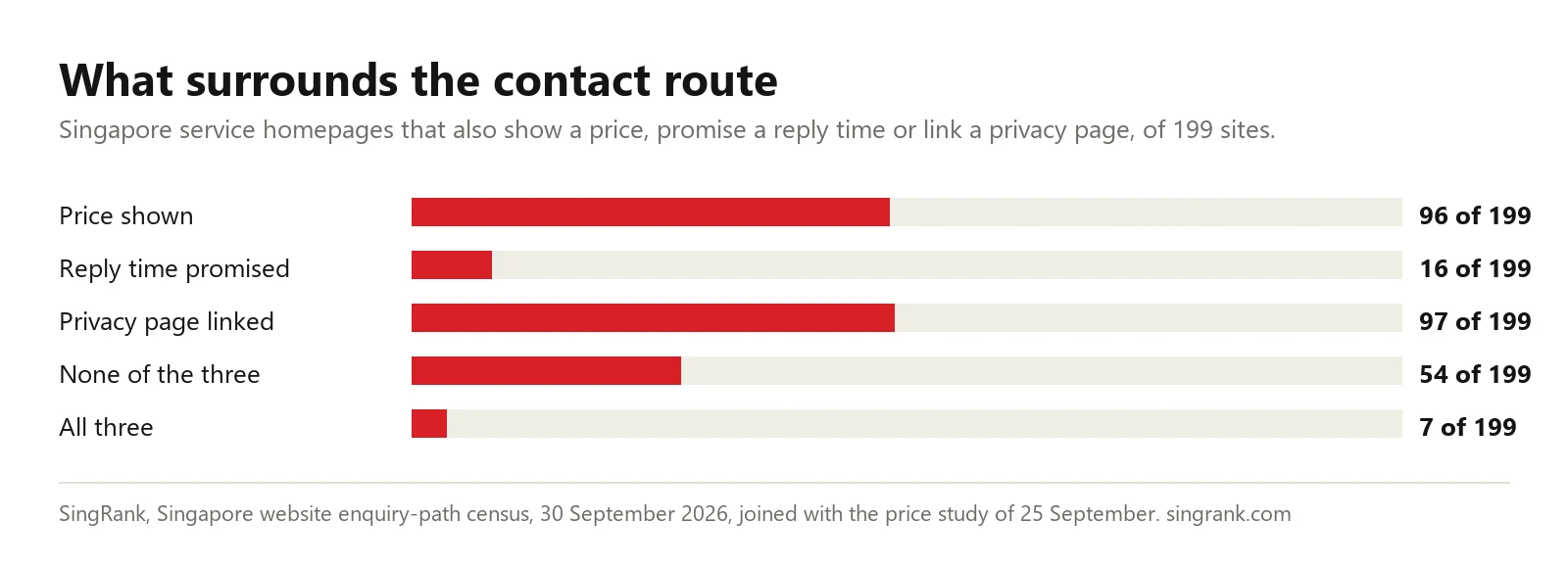
- Of the 199 sites we measured in both this census and our price study, 96 show a price, 97 show neither a price nor a reply promise, and only 7 show a price, a reply promise and a privacy link together.
What we counted, and on whose sites
We reused the sample from our price study of 219 Singapore service websites: 20 trades, from aircon servicing to divorce lawyers, limited to businesses that sell the service themselves. One of SingRank's own clients came up in that sample and was removed before anything was measured. Our editorial policy explains how we sample and what we never publish.
The sample is the same and the question is new. Of the 219 homepages, 201 could be read and judged; eight were JavaScript shells with almost no text, and ten refused us or didn't answer. Rates below use 201 unless we say otherwise.
We counted five kinds of direct route: a visible phone number, a tap-to-call link, a WhatsApp link, an email link, and a form that isn't a search box or a newsletter sign-up. We also looked for three things around the route: a price for the business's own service, a reply time in plain words, and a link to a privacy page. No business is named anywhere in this article.
191 of 201 already have a way in
Only 10 of the 201 homepages had none of the five routes in their page source. Nine of those still had a contact-style link, such as contact, book or quote. One had nothing at all. Opened in a real browser, it showed several routes once the page had rendered.
| Route on the homepage | Sites | Share of 201 |
|---|---|---|
| A phone number in the visible text | 172 | 86% |
| A tap-to-call link | 142 | 71% |
| A WhatsApp link | 120 | 60% |
| An email link | 103 | 51% |
| A form | 85 | 42% |
| Any of these five | 191 | 95% |
A smaller sample pointed the same way. In our car workshop website study, every one of the eight readable sites offered a clear route, mostly a phone number plus WhatsApp. Across 20 trades, the picture holds.
Our method reads the raw page, so chat widgets and scripted buttons are invisible to it. The true share is at least this high. 147 of the 199 sites we could compare offer three routes or more.
Website visitors but no enquiries: look before the button
If the route is there, look at what stands around it. Three things were easy to count.
A price. 96 of the 199 sites measured in both counts show a price for their own service. That leaves roughly half with no price on the homepage or on the one price page we followed.
A reply promise. 16 of 201 homepages say when the visitor will hear back, in words such as "we reply within an hour". On the other 185, nothing we could read says when an answer will come.
A privacy line. 99 of 201 link a privacy page from the homepage, and among the 85 homepages with a form, 43 don't. That doesn't prove the notice is missing, because it may sit on the contact page, which we didn't read. It does mean a visitor can't see it where we looked.
| On the homepage (199 sites measured in both counts) | Sites | Share |
|---|---|---|
| Price shown for the business's own service | 96 | 48% |
| Reply time promised | 16 | 8% |
| Privacy page linked | 97 | 49% |
| None of the three | 54 | 27% |
| All three | 7 | 4% |
Read the last two rows first. 54 of the 199 show none of the three, and 48 of those 54 still offer a direct route. Fewer than one in twenty show all three.
We joined the price column after seeing the main results, so treat this table as a description, not a test. It doesn't say the 7 sites with all three get more enquiries, because we didn't measure enquiries.
The stakes are easy to state. Search work is paid for month by month. Our smallest plan, Premium Starter, is S$500 a month with a three-month minimum, according to our pricing page. That is S$1,500 before the first review, and it buys visitors for a page that may still not say what your service costs or when anyone will answer. We'd rather you fix the page first.
What the PDPC pages say about the form and the follow-up
A contact form collects a name and a phone number, and Singapore's data protection regulator has published what that involves. Its page of data protection obligations lists a Notification Obligation, which means telling people why you're collecting, using or disclosing their personal data. It also lists a Consent Obligation, which ties that use to what the person agreed to.
Marketing follow-ups are a separate matter. PDPC's Do Not Call guide, published on 22 April 2026, says marketing messages to Singapore phone numbers need a DNC Registry check first, unless the recipient has given valid consent. That consent has to be a positive action tied to those messages, not buried in general terms and conditions.
The guide names voice calls, text messages and faxes. It doesn't name WhatsApp, so we can't tell you which side of the line a WhatsApp follow-up falls on. Ask PDPC or a lawyer, and don't take a blog's word for it, ours included.
The button is not the missing piece
Here's how I'd decide, as a view rather than a rule.
Your homepage already has a route. Most do, so don't add a sixth. Put the effort in front of the route and behind it.
You can't publish a price. Some trades rarely do: in the price study, only 1 of 15 maid agency sites showed an agency price. If that's you, publish how a quote works: what you need from the buyer, how long it takes and what it depends on. That's my suggestion and we haven't tested it.
You can't promise a fast reply. Then don't promise one. A promise you can't keep is worse than no promise, and that's our view, not something this census tested. Write the number you can keep and build the routine that keeps it.
Weak first impressions and unclear messaging may well be true for your site, and this census can't test them. It can say only that "you need a contact route" isn't a difference we found, because nearly everyone has one.
What I would do this week
Do these in order. Each is small on purpose.
- Day 1: walk your own path. On a phone you don't normally use, tap every contact route on your homepage and send a test enquiry through each. Note which fail.
- Day 2: put a price line above the button. A "from" price, a stated range or one plain sentence on how quotes work.
- Day 3: write a reply promise you can keep. For example, "We reply on WhatsApp within 2 working hours, 9am to 6pm." Use your own number and put it next to the button.
- Day 4: decide who answers. Name the person, forward the phone and set an out-of-hours auto-reply that says when the real reply comes.
- Day 5: add a privacy line to the form. One sentence on why you're collecting the number, plus a link to your policy. For marketing follow-ups, add a separate unticked box that names them, and check the wording against PDPC's guide.
- Day 6: send yourself an enquiry at 9pm. Time how long the reply takes.
- Day 7: start a log. One row per enquiry: date, route, your reply time and the outcome. Keep it for four weeks before you judge anything.
The strongest objection is that a WhatsApp button lifts enquiries. We found no sourced Singapore figure for that, and this census can't test it. Treat it as unproven, and change one thing at a time so the log can tell you something.
Method
We fetched each of the 219 homepages once on 30 September 2026. Our crawler names itself as SingRankStudyBot. It reads robots.txt first, skips anything the file disallows and waits a second between requests to the same site. It reads the page source and doesn't run JavaScript.
Tap-to-call, WhatsApp and email each mean a link of that type. A visible phone number is an eight-digit Singapore number in the text, with or without +65. A form counts if it isn't a search or newsletter form and has a message box or two text fields.
We checked our own reading two ways. In a real browser with JavaScript running, all 30 random homepages that the crawler said had a route showed one. The single homepage with no route showed one once rendered, but we didn't re-render all 201 pages. The price column comes from our price study after its hand review, and the deviations log is published beside the CSV. One more honest note: we wrote the plan before measuring, but we didn't keep a dated, hashed copy of it, and we finalised the wording of the headline claim after the numbers came in. The deviations log records both.
Limits
- Homepage only. A contact page may hold the reply promise, the price or the privacy notice. We didn't read it.
- Raw page, no JavaScript. Chat widgets and scripted buttons aren't counted, so route figures are a floor, and so are the reply-promise and privacy-link counts.
- A sample of what appears in search. It's the businesses our metasearch surfaced for 40 fixed searches, not a random draw of Singapore, and not Google's ranking.
- Counts, not causes. We measured what's on the page, not what makes a stranger enquire. This census can't say which fix works.
- No enquiry rates. SingRank hasn't measured its own enquiry rate for this article, and we haven't measured any business's.
This census starts after the visit. If people see you and don't click, read impressions but no clicks; if traffic itself fell, see why traffic dropped when rankings didn't. We also didn't look at your Google Business Profile, where a tap-to-call can start too. Our Google results-page census found a map pack ahead of the first organic result on 19 of 20 plain Singapore searches, which is one reason that profile is often the first thing a buyer sees.
Want your enquiry path read by a person?
Send us one page and we'll read its enquiry path by hand: what stands before the button, what happens after it, and what's missing. For the wider picture, see our SEO agency page for Singapore SMEs and our note on what SEO returns.
FAQ
Why is my website not getting enquiries?
We can't diagnose your site from a census. Here, 191 of 201 homepages already had a contact route, so a missing button is unlikely to be the reason. Check what stands around it: a price or quote process, a reply promise, a privacy line. Then test every route yourself.
Is a WhatsApp button on a website enough?
It's a route, not a reason. 120 of 201 homepages here already link to WhatsApp, and this census can't say whether a button produces enquiries. Only 16 of 201 tell the visitor when a message will be answered, which is a gap you can close in an afternoon.
Do I need PDPA consent on a contact form in Singapore?
PDPC lists a Notification Obligation and a Consent Obligation, so say why you're collecting the number and get consent for those purposes. For marketing messages to Singapore numbers, PDPC's guide says check the DNC Registry unless you have valid consent. This isn't legal advice.
Does showing a price help or hurt?
We can't say, because we didn't measure enquiries. 96 of 199 sites show one; in the price study 99 of 211 readable sites did. If you can't quote a figure, write how a quote works and what it depends on.
How fast should I reply to an enquiry?
We found no Singapore benchmark in a primary source, so we won't invent one. Only 16 of 201 homepages state a reply time. Pick a number you can keep on a bad day and time yourself with a test enquiry. With website visitors but no enquiries, start there.
How many contact routes do most Singapore service websites offer?
Most offer several. Of the 199 sites we compared, 58 offer three of the five routes, 70 offer four and 19 offer all five, so 147 offer three or more. Only 18 offer one route and 10 offer none in their page source.
Should I show a phone number, WhatsApp or a form?
This census can't say which produces more enquiries. It shows what sites do: 172 of 201 show a phone number, 142 a tap-to-call link, 120 a WhatsApp link and 85 a form. Three or four routes is the norm (128 of 199 sites), so pick the ones you can answer quickly.
How do I audit my own website's enquiry path?
Use the week plan above on your own homepage. On a phone, tap every route, note the price line, the reply promise and the privacy line, then send yourself a test enquiry and time the reply. By our estimate it takes an hour or so and needs no tools.
Cite this
SingRank, "Singapore Website Enquiry-Path Census 2026", https://singrank.com/blog/singapore-website-enquiry-path-census-2026/, collected 30 September 2026. Quote each figure with its base, such as 191 of 201 homepages. The anonymised file, one row per site with no names, is singrank-enquiry-path-census-2026.csv, and the deviations log sits beside it.