 SingRank
99 of 211 Singapore Service Websites Show a Price
Contents12
- Key figures
- What we measured, and on whose sites
- How many Singapore service websites show a price
- The industries that show prices, and the ones that do not
- Homepage or a separate price page
- What we did not count as a price
- Price transparency in Singapore: what the guidelines say
- Why some trades hide their prices
- What I would do this week
- Method and limits
- Want this checked on your page?
- FAQ
Fewer than half of Singapore service websites show a price. In a sample of 219 service-business websites across 20 industries, collected on 25 September 2026, 99 of the 211 we could read stated a price for their own service. The other 112 did not show a single dollar figure for the work they sell.
The split is not random. It follows the trade. Plumbers, aircon servicing firms and home cleaners mostly publish prices. Maid agencies, car workshops, tuition centres and accounting firms mostly do not.
That matters because your buyers ask the price question before they ask anything else. When you type "aircon servicing singapore" into Google, the second suggestion it offers is "aircon servicing singapore price". For "car servicing singapore", the third suggestion is "car servicing singapore price" and the fourth is "package". A page that does not answer that question sends the buyer back to the results.
Key figures
- 99 of 211 measurable Singapore service websites showed a price for their own service, 25 September 2026.
- 79 of those showed the price on the homepage. 20 showed it only on a separate price page.
- 1 of 15 maid agency websites showed an agency price. 1 of 14 car workshop websites showed a service price.
- 9 of 11 plumbers, 8 of 10 aircon servicing firms and 11 of 15 home cleaning firms showed a price.
- 13 pages our automated check first counted as "price shown" were not prices for the business's own service. We read every one of the 112 flagged pages by hand and removed those 13.
What we measured, and on whose sites
We picked 20 service trades that you probably hire yourself, from aircon servicing to divorce lawyers. For each trade we ran two searches through SingRank's own metasearch on 25 September 2026: the trade plus "singapore", and the trade plus "singapore price". From the results we kept only websites of businesses that sell the service themselves, up to 15 per trade. Directories, marketplaces, booking platforms, best-of lists and news sites were left out.
That gave 219 websites. One of SingRank's own clients came up in the sample; we removed it before measuring, so this study says nothing about anyone we work for. Our editorial policy sets out how we sample and what we never publish.
Our crawler identified itself by name. It read each site's robots.txt first and waited a second between requests to the same site. Then it read the homepage, plus one more page if the homepage linked to prices, rates, packages or fees. Eight sites couldn't be read at all. Six never answered (timeouts, connection or certificate errors), one returned a server error and one refused our request. That leaves 211 measurable sites.
A page counted as showing a price when the text you'd see had a Singapore-dollar amount close to a word for that trade's service: "from $16 per unit", "callout from S$100", "consultation $50". A typical range stated by the business ("general servicing typically costs $30 to $50 per unit") counts too, because the buyer still gets a number.
How many Singapore service websites show a price
Across all 20 trades, 99 of 211 measurable Singapore service websites showed a price for their own service. That's just under half.
Put the other way round: 112 Singapore service websites in this sample answer every question except the one buyers type first. They describe the service, list the areas they cover and give a WhatsApp number. They do not say what it costs.
Our earlier, smaller studies pointed the same way. In our car workshop website study, none of the 8 readable pages showed a price. In our study of mover price searches, 34 of 86 search suggestions asked about price. This census is the first time we have counted it across many trades at once.
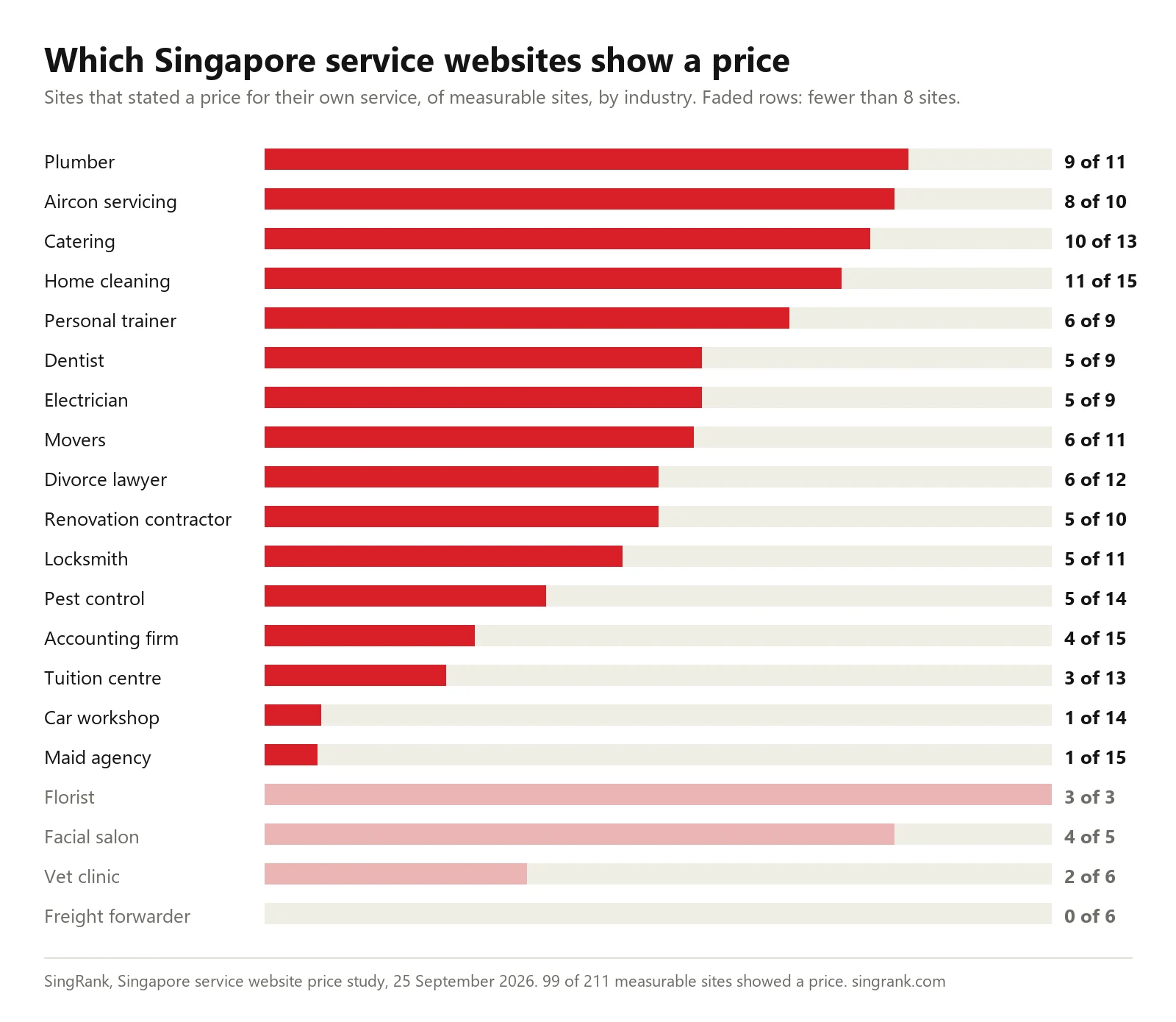
The industries that show prices, and the ones that do not
| Industry | Price shown | Measurable sites | Share |
|---|---|---|---|
| Plumber | 9 | 11 | 82% |
| Aircon servicing | 8 | 10 | 80% |
| Catering | 10 | 13 | 77% |
| Home cleaning | 11 | 15 | 73% |
| Personal trainer | 6 | 9 | 67% |
| Dentist | 5 | 9 | 56% |
| Electrician | 5 | 9 | 56% |
| Movers | 6 | 11 | 55% |
| Renovation contractor | 5 | 10 | 50% |
| Divorce lawyer | 6 | 12 | 50% |
| Locksmith | 5 | 11 | 45% |
| Pest control | 5 | 14 | 36% |
| Accounting firm | 4 | 15 | 27% |
| Tuition centre | 3 | 13 | 23% |
| Car workshop | 1 | 14 | 7% |
| Maid agency | 1 | 15 | 7% |
| Facial salon | 4 | 5 | small sample |
| Florist | 3 | 3 | small sample |
| Vet clinic | 2 | 6 | small sample |
| Freight forwarder | 0 | 6 | small sample |
Trades with fewer than 8 measurable sites are shown but not ranked, because one site more or less would swing the share by 13 points or more.
The pattern is easy to read. Jobs that are small, repeatable and priced per unit or per hour (a servicing visit, a cleaning session, a blocked toilet) are usually priced in public. Jobs that depend on the case (a car's fault, a helper's placement, a company's books, a child's level) usually are not.
That is a reason, not an excuse. A car workshop cannot fix a price for an engine fault it has not seen. It can publish what an inspection costs, or a range for a standard servicing package. In this sample, one did.
Homepage or a separate price page
Of the 99 sites that showed a price, 79 put it on the homepage. The other 20 kept it on a separate page, linked from the homepage as "Rates", "Pricing" or "Price list".
Both work if you click. They aren't equal when you're on a phone and decide from the first screen. A price on the homepage answers the question where you already are.
Among trades where at least five sites showed a price, electricians and locksmiths were the most likely to keep it one click away: 3 of the 5 electricians and 3 of the 5 locksmiths that showed a price did it only on a price page.
What we did not count as a price
An automated check that looks for dollar signs will count things that are not prices. So we read every page it flagged, all 112 of them, and removed 13.
They're worth listing, because each one looks like a price to a machine and isn't a price to you as a buyer:
- Car workshops: prices of cars for sale, and Certificate of Entitlement premiums, on 3 workshop homepages.
- Maid agencies: a government levy, helper salaries on candidate profiles, a salary level set by an embassy, a news item, a government e-learning fee, and another agency's fees quoted for comparison, on 6 agency pages.
- Others: a tax-relief amount, an insurance cover limit, a fee comparison table about other providers, and a price quoted inside a customer's complaint.
Maid agencies are the clearest case. Our first automated count found 7 of 15 "showing a price". After reading the pages, only 1 showed its own agency fee. The rest showed the numbers around the service, the levy and the salary, and left the agency's own fee out.
Price transparency in Singapore: what the guidelines say
The Competition and Consumer Commission of Singapore (CCS) publishes Guidelines on Price Transparency. They do not require a business to publish prices on its website. They set out how to show a price once you do.
On drip pricing, the guidelines ask that unavoidable or mandatory charges such as taxes, surcharges and service fees be "included in the total headline price". When a charge can't be worked out in advance, the business should say clearly, next to the headline price, that it exists, according to the CCS Guidelines on Price Transparency.
In practice, if you publish a from-price, say what it includes, and don't let a callout fee appear for the first time on the invoice. 17 of the 99 sites that showed a price also said whether it included GST, or marked it nett.
Why some trades hide their prices
It would be easy to call the low scorers lazy. I don't think that's fair, and the pages themselves show why.
A maid agency's real cost to you is a bundle: the agency fee, the helper's salary, the government levy, government fees and insurance. Most of those are set by someone else.
The agency pages in this sample published the parts they don't control and left out the one part they do. I think that's backwards. The agency fee is the number you're comparing between agencies, and it's the one you couldn't find on 14 of 15 pages.
A car workshop has a different problem. It can't price a fault it hasn't seen, and a low headline price for "servicing" invites the wrong comparison. That's a real risk.
But the price question doesn't go away when the page stays silent. You'll ask it anyway, on a forum, a comparison site or an AI assistant, and the answer you get there won't be the workshop's.
Accounting firms and tuition centres sit in between. Their work is quoted per client or per level, yet the firms that did show a price in this sample did it simply: a starting package, a price per class, a line saying what changes it.
My view, and it is a view rather than a measurement: in 19 of the 20 trades in this sample, at least one business found a way to show an honest number. The ones that didn't mostly haven't tried.
What I would do this week
If you run a service business in Singapore and your website shows no price, here is what I would do, in this order:
- Search your own trade the way a buyer does. Type your service and "singapore" into Google and read the suggestions. If "price" or "cost" appears, that is the question your homepage has to answer.
- Publish one honest number. A starting price with what it includes, a callout or inspection fee, or a range with the two or three things that move it. Not a fixed quote for every job, and not silence.
- Put it where the buyer already is. The homepage, in plain text, not only inside an image or a PDF. A separate price page is fine as long as the homepage links to it by name.
- Show what is extra. GST, transport, after-hours charges. That is what the CCS guidelines ask for, and it is what stops a price from turning into a complaint.
- Check it reads as text. Paste your homepage into a plain-text viewer. If the price disappears, a search engine and an AI assistant cannot see it either.
A page that answers the price question gives your buyer and an AI assistant something to quote. A page that doesn't leaves them to quote someone else.
Method and limits
We would rather you know exactly what this sample can and cannot carry.
- The sample comes from metasearch, not Google. The 40 searches ran through SingRank's self-hosted SearXNG on 25 September 2026. It blends other engines and is not Google's ranking or its Maps pack. Most queries returned 10 to 15 results, so the sample is 219 sites, not the 300 we planned.
- Two trades are not strictly comparable. On the day, one engine returned results only for the catering and maid agency searches, so those two samples were drawn from a different mix.
- Raw HTML only. We did not run JavaScript. A price shown only in an image, a PDF or a script-loaded widget is invisible to this method, so the true share may be slightly higher.
- One extra page at most. We read the homepage and at most one linked price page. A price buried three clicks deep is not counted.
- Every positive was read by hand. 112 pages were flagged automatically; 13 were removed after reading. We also read 30 random "no price" pages from the final results and found no missed price; the dollar figures on them were car sale prices, helper salaries, an insurance limit and a "worth $250" free consultation.
- Small trades are not ranked. Florist, facial salon, vet clinic and freight forwarder had fewer than 8 measurable sites each.
- A bug we fixed before publishing. Our first run treated any page that loaded a reCAPTCHA form as a bot check and set 16 sites aside. We narrowed the rule to real challenge pages and measured those 16 again; 5 of them showed a price.
- We name no business. This page describes a sample of websites, not a rating of any company. Our own clients were excluded.
- Dates are UTC. The searches and the page fetches all ran on 25 September 2026; the final measurement pass finished at 03:59 UTC.
The industry totals are available as a CSV file from the citation box at the end of this page. It contains counts only, no business names.
Want this checked on your page?
Send us the one page that should answer your customers' price question. We will read it the way a buyer and an AI assistant do and tell you what they can see today. It starts as a free visibility check through our contact page.
If you want Singapore service websites like yours to answer the price question properly, our SEO, AEO and GEO programme covers pages like these. Trade-specific advice is in our guides for plumbers and maid agencies, and our AI search readiness study covers the other checks an AI assistant runs on a local page.
Findings describe 219 websites sampled on 25 September 2026. This page names no business and is not a rating of any company.
FAQ
How many Singapore service websites show a price?
In our sample of 219 service-business websites across 20 industries, collected on 25 September 2026, 99 of the 211 we could read showed a price for their own service. 79 showed it on the homepage and 20 only on a separate price page.
Which Singapore industries are most likely to show prices online?
Plumbers (9 of 11), aircon servicing firms (8 of 10), caterers (10 of 13) and home cleaning firms (11 of 15) were the most likely in our sample. These are jobs sold per unit, per hour or per headcount, which are easy to price in advance.
Which industries are least likely to show a price?
At the bottom of the table sat maid agencies at 1 of 15, car workshops at 1 of 14, tuition centres at 3 of 13 and accounting firms at 4 of 15. Maid agency pages often showed the government levy and helper salaries but not the agency's own fee.
Do Singapore businesses have to publish prices on their website?
No. The CCS Guidelines on Price Transparency do not require a price on a website. They say that when a price is shown, unavoidable or mandatory charges such as taxes, surcharges and service fees should be included in the total headline price, or clearly disclosed with it when they cannot be calculated in advance.
Why did you remove some prices after the automated check?
Because a dollar sign is not always a price. Our check flagged 112 pages; reading them showed 13 were car sale prices, government levies, helper salaries, competitors' fees, a tax-relief figure or a price inside a customer complaint. Those were counted as "no price".
Can I cite these figures?
Yes. Please cite "SingRank, Singapore Service Website Price Study 2026" with a link to this page and the collection date, 25 September 2026. Quote each figure with its base, such as 99 of 211 sites, and keep the metasearch caveat. The industry totals for all 219 Singapore service websites can be downloaded as a CSV from the citation box.