 SingRank
Local SEO Areas Singapore: 265 of 620 Searches Kept the Town
Contents14
- Key findings
- Why "which town?" is the wrong first question
- What we counted
- Hit counts vary more by trade than by town
- Then the town
- What people add after the town name
- What Google says about a page per town
- Local SEO areas Singapore: how I would use the map
- A 30-minute check for your own trade
- Method
- Limits
- Want us to read your trade's map?
- FAQ
- Cite this
On 30 September 2026 we typed 620 searches into Google's autocomplete: 20 Singapore trades in each of 31 towns and districts. 265 of 620 came back with a completion that keeps the town. The biggest gap is between trades, not towns: dentist got one in 29 of 31 places, while for seven other trades Google offered nothing in 171 of 217 searches. For local SEO areas Singapore businesses can target, check your trade first.
Key findings
- 265 of 620 trade-and-town searches returned a completion that names a Singapore town, counted on 30 September 2026 with the scoring rule we explain in Method.
- Hit counts vary more by trade than by town. Six trades (dentist, florist, locksmith, facial salon, vet clinic, tuition centre) reached 148 of 186 trade-and-town pairs, or 148 of 172 when Google offered any completion. Seven trades (accounting firm, movers, renovation contractor, divorce lawyer, freight forwarder, pest control, home cleaning) reached 13 of 217, but for 171 of those 217 searches Google offered no completion at all.
- Towns vary less than trades. Trades ranged from 0 to 29 of 31 towns. Towns ranged from 1 to 15 of 20 trades, with a median of 10. Tampines had 15, Yishun 14 and Bedok 13.
- Central and West are lowest, and we don't know why. Without the eight shared-name towns, Central still has the lowest share, 49 of 120 searches, then West with 50 of 120, against 57 of 100 in the North-East and 48 of 80 in the East.
- Autocomplete is not search volume. A completion shows that people type a phrase. It doesn't show how many do.
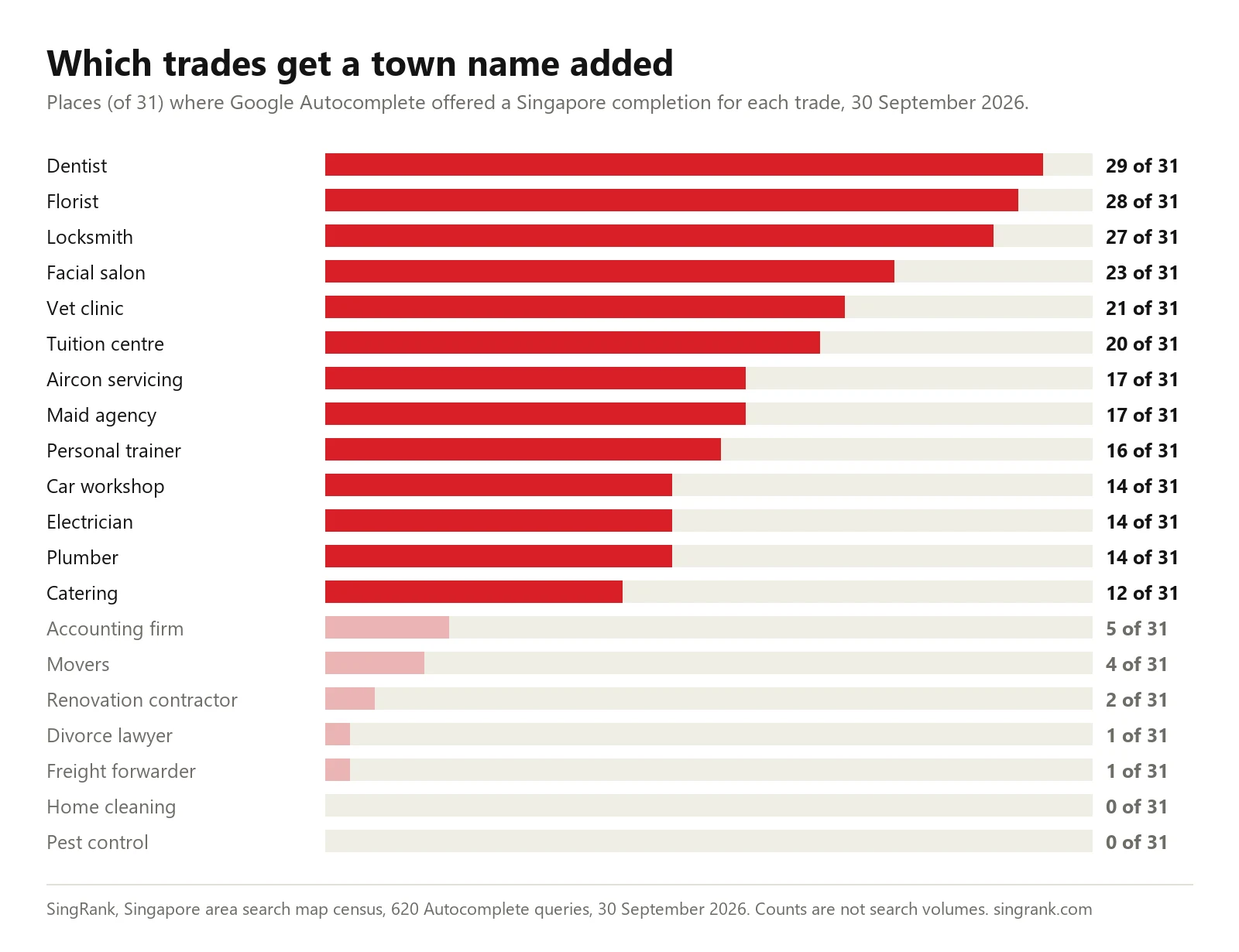
For each trade, the number of the 31 towns where Google offered a completion naming the town, 30 September 2026.
Why "which town?" is the wrong first question
In a blended metasearch on 30 September 2026, all ten top results for which area to target for local SEO Singapore were guides, and none was a count. The advice we've met, in guides and in AI answers, is to build location pages Singapore-wide, one for every town. That treats SEO by town Singapore as one job, whatever the trade.
That advice skips a step: it never checks whether people in your trade add a town name to the search at all.
We saw a small piece of this before. Our estate-level autocomplete study read three estates. Searchers named malls and centres in two of them, and Woodlands turned out different: 13 of 39 suggestions named a place outside Singapore.
That was three searches. This count asks the wider question. Across 20 trades and 31 towns, where does a town name get added, and where doesn't it?
What we counted
We used the same 20 trades as our Google first-screen study, from aircon servicing to freight forwarding. We paired each with 31 towns and districts and typed the trade and the town the way a customer would, for example dentist tampines. That made 620 searches.
The towns fall into the five regions our regional guides use: Central, East, North, North-East and West. Google's autocomplete help page says predictions come from real searches. It adds that Google also weighs language, location, trending interest and your own past searches.
We typed the town ourselves. A search counts as a hit when Google returned at least one completion that keeps the town, includes a word for the trade, and isn't a place in another country, such as dentist tampines mart. It doesn't mean Google guessed the town. We saved every completion.
Hit counts vary more by trade than by town
Sort the 20 trades by how many of the 31 towns Google completed, and three groups appear. The last column leaves out searches where Google offered nothing.
| Group | Trades | Hits | Searches with no completion at all | Hits among searches that got any completion |
|---|---|---|---|---|
| Town completed almost everywhere | Dentist 29, florist 28, locksmith 27, facial salon 23, vet clinic 21, tuition centre 20 | 148 of 186 (80%) | 14 of 186 | 148 of 172 (86%) |
| Town completed about half the time | Aircon servicing 17, maid agency 17, personal trainer 16, plumber 14, electrician 14, car workshop 14, catering 12 | 104 of 217 (48%) | 27 of 217 | 104 of 190 (55%) |
| Google mostly offered nothing | Accounting firm 5, movers 4, renovation contractor 2, divorce lawyer 1, freight forwarder 1, pest control 0, home cleaning 0 | 13 of 217 (6%) | 171 of 217 (79%) | 13 of 46 (28%) |
Each trade figure is the number of the 31 towns where Google completed that trade with a town name. For a dentist, a florist or a locksmith, Google did so in nearly every town. For a pest control firm or a home cleaner, it did so in none, and that zero is mostly silence: Google returned no completion at all for 21 of the 31 pest control searches and 27 of the 31 home cleaning searches.
In the bottom group, 171 of the 217 searches returned no completion at all. That is 171 of the 212 empty responses in the whole run. So the finding for these seven trades is about the phrase, not about towns: for about four in five of these searches, Google offered nothing to complete.
We don't know why. It could reflect how rarely people type these phrases, the endpoint we used, or where our requests came from.
The top group had only 14 empty responses in the same run, so throttling looks unlikely, but we haven't proved that. A zero here isn't proof that nobody searches for pest control in Tampines. It also doesn't show what a town page would do.
Then the town
Towns differ less. Across the 20 trades, towns ranged from 1 to 15 hits, with a median of 10.
- Most often completed: Tampines 15, Yishun 14, Bedok 13, then Toa Payoh, Pasir Ris, Ang Mo Kio, Hougang, Punggol and Bukit Batok at 12 each.
- Least often completed: Tuas 1, Kallang 2, Marine Parade 2 and Bishan 4.
Tuas is an industrial area, so residents may rarely add it to a search, but we didn't test that. Kallang, Marine Parade and Bishan are also affected by our stricter scoring for shared names, which we explain below.
| Region | Hits | Searches | Share | Share without the shared names | Towns with the most |
|---|---|---|---|---|---|
| North-East | 57 | 100 | 57% | 57% | Punggol, Hougang, Ang Mo Kio 12 |
| East | 53 | 100 | 53% | 60% | Tampines 15, Bedok 13 |
| North | 32 | 60 | 53% | 52.5% | Yishun 14, Woodlands 11 |
| West | 55 | 140 | 39% | 42% | Bukit Batok 12, Choa Chu Kang 11 |
| Central | 68 | 220 | 31% | 41% | Toa Payoh 12, Bukit Merah 10 |
Read this table as description, not as a league. Regions have different numbers of towns, from 3 in the North to 11 in Central.
Eight names are also places elsewhere, or common words: Orchard, Woodlands, Queenstown, Marine Parade, Clementi, Changi, Kallang and Bishan. For those we only counted a completion with clear Singapore evidence.
Leaving those eight out, Central is still lowest with 49 of 120 searches, West is next with 50 of 120, the North-East has 57 of 100 and the East 48 of 80. We don't know why Central and West sit lower, and this map can't say that they are low-interest regions.
Our guides cover the local detail for each region: Central, East, North, North-East and West.
What people add after the town name
Some completions carry more than the town. Real examples include dentist tampines mart, florist bukit timah plaza and dentist bishan junction 8.
That fits our estate-level study. The words after the town are often a mall, station or street. We didn't count them, so we give no number.
What Google says about a page per town
Google's spam policies define doorway abuse as pages built to rank for specific, similar searches. Google describes these as pages that funnel people towards intermediate destinations less useful than the real one.
Two of Google's examples matter here, and they are separate. One is a set of pages built for "specific regions or cities" whose job is to funnel users to one page. The other is "substantially similar pages" that sit closer to search results than to a clearly defined hierarchy you can browse.
That's narrower than a ban on town pages. A page for a place you really serve, with facts that belong to that place, is a different thing.
Google's text doesn't say how many pages is too many. As we read it, the test is usefulness, not count.
Local SEO areas Singapore: how I would use the map
This is our view, built on the count and on Google's text. It isn't a rule, and the cut-offs below are our own rules of thumb, which we haven't tested.
The verdict first: check the trade before you pick a town. Where Google clearly adds town names, town pages are worth considering. Where it offered nothing, this count can't say.
I'd rank the towns by where your customers live, not by our counts. And I wouldn't build a page for any town where you can't say something that is true only there. Between a few well-built pages and a fleet of thin ones, I'd choose the few.
If you're a dentist, florist, locksmith, facial salon, vet or tuition centre, town names are part of how people search. A page or section for each location you really serve makes sense. Fill each with what only that place has: the address, the nearest MRT exit, the mall or centre, the opening hours. Start with your Google Business Profile, and read our local SEO guide for the Maps side.
If you work in aircon, maid agency, personal training, plumbing, electrical, car workshop or catering, towns get added about half the time. Choose the three to five towns where your customers live and where you have proof, such as jobs done and reviews, and stop there. Our trade guides for aircon servicing, plumbers and electricians go into the rest.
If you're an accountant, mover, renovator, divorce lawyer, freight forwarder, pest controller or home cleaner, Google offered no completion for most of these searches (171 of 217), so this count can't tell you whether town pages would help. It isn't evidence that they work, and it isn't evidence that they don't.
Put the effort first into one strong service page, your profile and your reviews. If you add town pages later, start with a few towns you really serve, and check your own Search Console queries before adding more.
Our guides for pest control, cleaning companies and law firms cover those trades.
Current offer: Dominator (20 articles a month) is S$600/month until 31 December 2026, normally S$1,000. See all prices.
There's a cost to guessing wrong. At the pace of our own Premium Starter plan, which is 10 articles a month at S$500 a month with a three-month minimum according to our pricing page, twenty town pages is two months of that plan. That's S$1,000 of writing before you know whether anyone types the phrase.
We publish a regional page for each part of Singapore, so this count cuts against our own habit.
A 30-minute check for your own trade
By our estimate it takes 30 minutes, against the two months of writing above. You need a laptop, a notebook and a private browser window.
- Write your trade the way customers say it, for example aircon servicing, not your company's category.
- List five towns you serve.
- Open a private window, go to Google and type the trade and a town, slowly. Don't press Enter. Write down every completion.
- Mark a town as a hit only if a completion names the town and your trade, and is in Singapore. Watch for shared names: Woodlands, Queenstown and Orchard all exist elsewhere.
- Repeat with two other phrasings of your trade, and note the date and time.
- Repeat tomorrow. Completions change, and one look isn't enough.
- Read the result. Four or five towns out of five suggests town pages may help. Zero or one gives this test no support for them, so check your Search Console queries before deciding.
Method
We ran 620 queries for 20 trades and 31 towns against Google's public autocomplete endpoint on 30 September 2026. We set the country to Singapore and English as the language, and sent one request every 1.3 seconds under a named user-agent. There were no errors.
The requests came from an Indonesian network address, and Google may weigh that. We saved every completion.
We wrote down the counting rule before collecting. It was a substring match with a list of foreign-place markers. When we read the hits for the shared names by hand, as planned, that rule was wrong. It gave 319 hits of 620, and it counted orchard park and port orchard in the United States, queenstown tasmania, kallangur in Queensland, changing and clementine.
A stricter second rule required explicit Singapore evidence for every town. It gave 157 hits. Of 30 cells it dropped that we checked by hand, about two thirds looked like genuine local completions, such as pet clinic tampines.
So we wrote a third rule. It matches whole words for every town, needs a trade word for all, and drops completions that carry a foreign-place marker such as a US state code or Queensland. It also requires explicit Singapore evidence for the eight shared names only. This rule gave the 265 hits reported here, and we chose it after seeing the results, so it wasn't written down in advance.
The Singapore-evidence list for the eight shared names is loose. It accepts words such as road, rd, central and st 22. A few UK completions passed on it, for example dentist woodlands road camberley, beauty salon woodlands road st helens and locksmith peach orchard road. None of them changed a hit, because each of those cells also had genuine Singapore completions.
Across the eight names, 22 completions pass only on such weak words, and some are genuine, such as orchard road. So the CSV column valid_suggestions is inflated for Woodlands and Orchard and slightly for the others. The hit column is unaffected, and we didn't change the CSV.
We checked the final rule on a fresh random draw. All 30 random hits were genuine Singapore completions. Of 30 random non-hits that had suggestions, about 3 looked like genuine local completions dropped by the shared-name rule. So the count looks slightly conservative for those names.
We chose the headline ratio and the claim wording after seeing the counts. The three trade groups, the empty-response counts by group, the hit rate among searches that got any completion, and the regional shares without shared names were also worked out after the counts.
We also didn't keep a dated, hashed copy of the plan before collecting. The deviations log records all of this. The anonymised CSV has one row per search.
Limits
- Autocomplete isn't volume. We know a phrase was offered, not how often it is typed.
- A zero mostly means Google said nothing. In the bottom group 171 of 217 searches returned no completion at all. We don't know whether that reflects low query frequency, the endpoint or where our requests came from. It doesn't mean nobody searches the phrase, and it doesn't show that town pages would fail.
- One day, one endpoint, English only. Completions shift with time, location and past searches.
- The region grouping is ours. The URA Master Plan 2025 regional plans page names the regions but doesn't list every planning area, so we used the grouping of our own regional guides.
- Trade words can miss synonyms. A trade searched under another name would score low.
- No town is ranked by customers or money. This is a map of phrases, not a market size.
- No business is named.
Want us to read your trade's map?
Send us your trade and up to five nearby towns. We'll run this autocomplete check on a clean browser and tell you, in writing, whether a town page makes sense in your local SEO areas Singapore plan. It's the starting point of our SEO agency work for Singapore SMEs.
FAQ
Which local SEO areas Singapore owners should target first?
Start with your trade, not the map. Dentists, florists and locksmiths were completed with a town name in at least 27 of 31 towns. For pest control and home cleaning Google mostly returned no completion at all, so this count can't say whether town pages help those trades.
Should I build a page for every town?
Not from this count. Where a trade carries a town name, a page for each place you really serve can help if it holds facts unique to that place. Google's spam policy names pages for "specific regions or cities" whose job is to funnel users to one page, and "substantially similar pages", as two separate doorway examples.
Which Singapore towns were completed most often?
Tampines had 15 of 20 trades, Yishun 14 and Bedok 13. Those are counts of phrases Google completed, not of customers or searches. They show where a town name is often added, not where the money is.
Does a completion mean many people search it?
No. Google says predictions come from real searches and also reflect location, trends and your past searches. A completion shows the phrase exists. It doesn't tell you how often it is typed.
Why did Orchard, Woodlands and Queenstown need special rules?
They are also places elsewhere. Our first rule counted orchard park, port orchard and queenstown tasmania. For eight shared names we only counted completions with explicit Singapore evidence, which makes those towns look lower than they may be.
Is my trade in your list?
We tested 20 trades. If yours isn't one of them, run the 30-minute check above with your own phrases and five towns.
Is a page per town against Google's rules?
Not by itself. Google's doorway examples include pages for "specific regions or cities" whose job is to funnel users to one page and, separately, "substantially similar pages". A page for a place you really serve, with facts that belong to it, is different.
Cite this
SingRank, "Singapore Area Search Map Census 2026", https://singrank.com/blog/singapore-area-search-map-census-2026/, collected 30 September 2026. Quote each figure with its base, such as 265 of 620 searches, and keep the Limits with it. Anyone weighing local SEO areas Singapore can download the anonymised file, one row per search with no business named: singrank-area-search-map-census-2026.csv. The deviations log sits beside it.